Download David Brinkley
To overcome your daily problems, related to your jobs, this book can be read page by pages. Of course, when you have no deadline jobs, you will also need what offered by this book. Why? It serves something interesting to learn. When you really love to read, reading something, what you can enjoy is the topic that you really know and understand. And here, David Brinkley will concern with what you really need now and you need actually for your future.
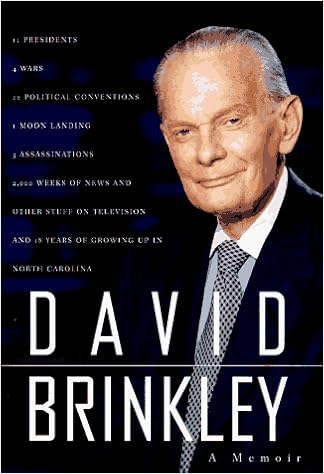
David Brinkley

Download David Brinkley
Just what do you do to start checking out David Brinkley Searching the e-book that you enjoy to review initial or discover an intriguing e-book David Brinkley that will make you would like to check out? Everybody has difference with their factor of checking out a publication David Brinkley Actuary, reading practice must be from earlier. Many individuals could be love to check out, but not a book. It's not mistake. Somebody will be bored to open up the thick book with small words to check out. In even more, this is the actual condition. So do occur probably with this David Brinkley
A referred will certainly be opted to obtain the exact ways of exactly how you make the deal of the situation. As what we refer, David Brinkley has a number of objectives for you to pick as one of the sources. Initially, this is extremely linked to your trouble now. This publication also offers basic words to utter that you can digest the information quickly from that book.
Well, also this publication is given in different with the published publication; it will certainly not huge issue. You know why this web site has numerous fans? Well, all noted publications have the soft file. It is supplied based on the title. When you look at the internet site in this web page, locating the link to get this David Brinkley is simple. Simply follow it and also find the book.
The choice of you to read this book is not based upon the force to review it. it will certainly begin to make you really feel that this book is extremely proper to check out in this time. If occasionally you will certainly additionally compose your suggestions right into a book, discovering form this publication is an excellent way. David Brinkley is not only the analysis book. It is a publication that has amazing experience of the globe. Guide inspires to obtain much better future. This is the reason you need to read this book, even the soft data book, you could get it. This is exactly what you require now to challenge your idea of habit.
Amazon.com Review
Although the Election Night '96 dust-up in which Brinkley unfairly trashed Bill Clinton may have momentarily obscured it, the truth is he's one of the most insightful political commentators ever to appear regularly on television. He's also had tremendous timing: after some short stints at small newspapers in little Southern towns, Brinkley became NBC's White House correspondent in 1943, and after FDR, went on to cover ten other presidents. (He became particularly friendly with LBJ.) In the process, Brinkley became an expert on the folkways of Washington, D.C. As reported here, when Brinkley was preparing for the broadcast of the first moon landing, he asked the director of NASA about the significance of the event. "David," came the reply, "if this all works I can get Congress to raise my budget to $20 billion next year."
Read more
From Publishers Weekly
Born in 1920 and raised in Wilmington, N.C., Brinkley began writing for the local paper in high school. He soon graduated to the United Press and, by WWII, was working for NBC Radio in Washington, D.C. It was there that he covered his first president, FDR ("a social snob"); was present at Churchill's famous "Iron Curtain" speech in 1946; and witnessed the miracle election of Truman in 1948. He slowly moved into TV and was paired with Chet Huntley at the 1956 political conventions. Their immediate chemistry led to the top-rated Huntley-Brinkley Report on the NBC Network. Brinkley reminisces about his friendship with Robert Kennedy; tells a hilarious story about how LBJ garnered votes from the cemetery; remembers how he first came across a "rural tinhorn" who went on to become Senator Jesse Helms; and recalls how it felt to be #1 on Nixon's enemies list. He also recounts how he left NBC and joined ABC to host This Week With David Brinkley. He gives his crusty opinion of both political parties: "I find one to be about as bad as the other and both pretty bad." The only thing that mars this work is Brinkley's diatribe against taxes, which comes off as the ramblings of a grump. A thoughtful, breezy, anecdotal work. Photos. 150,000 first printing; BOMC and QPB selections. Copyright 1995 Reed Business Information, Inc.
Read more
See all Editorial Reviews
Product details
Hardcover: 273 pages
Publisher: Alfred A. Knopf Inc.; 1st edition (October 10, 1995)
Language: English
ISBN-10: 067940693X
ISBN-13: 978-0679406938
Product Dimensions:
6.8 x 1.5 x 9.5 inches
Shipping Weight: 1.6 pounds (View shipping rates and policies)
Average Customer Review:
4.3 out of 5 stars
20 customer reviews
Amazon Best Sellers Rank:
#1,940,631 in Books (See Top 100 in Books)
I recently came across a VHS tape I had made of one of his "This Week" programs for ABC. Kissinger was the main guest and all the usual suspects were there. Brinkley died nine years ago and it had been awhile since I had thought about him. "This Week" was Brinkley's second act disproving the F. Scott Fitzgerald line about second acts. Those were shows I watched with my parents as I had watched him before with them. I had meant to read his books at the time but I was busy with other things.I first saw him on the Huntley Brinkley Report when I was around 8 or 9 years old. My parents and grandmother watched them religiously even when the broadcast was only 15 minutes long. I don't believe they ever watched Walter Cronkite or Howard K. Smith. Huntley was the hard news guy and Brinkley was the softer, easy going worldly guy with a tart sense of humor. I think he influenced me in that I've always been a slow talker and much criticized for it, but Brinkley showed how you could be a slow talker if you had something important and funny to say.In this, his autobiography, Brinkley writes candidly of his unhappy childhood. His mother had been embarrassed and ashamed of having gotten pregnant at 42. His father died when he was six. But, he benefited from the kindnesses of librarians and teachers. He would read at night under the light of a street lamp to avoid the warfare inside the house. He also won a slogan writing contest, which helped him to see a future for himself.He makes a point of how the stars of radio did not succeed on television, and it was a similar point that Marshall Mcluhan made long ago about television being a cool medium. Brinkley's idea was much simpler: the TV newscaster does not need to frantically describe what the viewers are seeing on the screen. Television was unlike radio, where broadcasters had to describe everything and keep filling the time with talk.Brinkley's description of himself, his likes and dislikes, his friends and enemies, fits the profile of the cold war liberal who went to the right parties and had the popular views of the time in the late 50's and early 60's. Although, he doesn't mention it in his book, I remember election night 1966 when asked to sum up the results when Ronald Reagan was elected Governor of California and the Republicans picked up 66 seats in the house, Brinkley said as his final comment, "The liberal hour is over, Chet." He was right. The era of consensus in America had broken down and on the road to polarization. It was also coming near the end of his distant partnership with Chet Huntley.He mentions his show David Brinkley Reports and claims it as a forerunner of 60 Minutes. I only remember two shows from that series, one on slumlords in Brooklyn and another on Route One, the original highway from Maine to Florida. They were excellent shows.Brinkley's second act was Sunday's on ABC. He was by then the wise, old curmudgeon who had seen everything, was asking questions of the panelists, and telling a humorous story at the end. By then, The show was built around his strengths, but in this book, he offers a sketchy account of it. He made it look very easy, which is the mark of any pro. He does discuss that his views evolved about government and taxes. He was much more skeptical about government taxing and spending and was candidly motivated by his higher income and the bigger bite they were taking out of his pay.The book does jump around and gets almost slapdash at the end. It resembles his career which went out on several sour notes. He admits to not remembering some important on the air moments. Imperfect as it is, it is his account of himself and it is all we have about him. A better book showing his reporting skills was his book "Washington Goes to War." He remains an immensely influential figure of my childhood years.
I enjoyed this because I grew up as a contemporary of Brinkley...he was old enough to be my father but he was a household word (Huntley/Brinkley) on radio and TV when it became also a household word. I come from a radio/TV family and loved the historical accuracy as well as the anecdotes. It is a very nostalgic view, also accurate of being a kid in the 1930's and '40's. I liked that he was a true reporter and there is little or no "slant" to his journalistic writing of the book. He pretty much just tells it like it was. If one has enjoyed Tom Brokaw's "Greatest Generation" I am sure they would also enjoy David Brinkley.
It was especially interesting to read about the difficulties for newsmen who were used to reading the to having to speak without a script. It was also fun to relive the election nights where results crept in as they came from different time zones in the days before algorithms allowed the results to be announced before the official counts were in.
Especially today, time spent with David Brinkley is time well spent.
A truly wonderful autobiography of one of America's journalist icons. The story of a boy who grew up in the small southern town of Wilmington, North Carolina in the heart of the Great Depression. In his adult years Brinkley tells in great detail of his involment with Presidents, politics,war,moon landing, assassinations, and the growing up of television. A truly wonderful read - 5 stars !
Quite a bit I didn't know about the man himself. Great insights.
Excellent read, especially if you're a native Wilmingtonian.
From 1956 to 1970, before the days of Dan Rather on CBS, Chet Huntley and David Brinkley said "good night" to each other at the 'finis' of NBC network news, leaving everybody watching feeling a kind of contentment that "all's right with the world." After his first eighteen years spent growing up, working for the small town newspaper, in North Carolina, his tenure fin the world of television news saw him through four wars, three assassinations, two wives, twenty-two political conventions, eleven presidents, 2,000 weeks of canvassing and reporting the news to the American public and one moon landing, he is on terra firma at last. Born in Wilmington, and educated at the University of North Carolina at Chapel Hill, and Vanderbilt University at Nashville, Tennessee, he spent most of his life on the Washington, D.C. scene. He had a soft Southern drawl and a knack for brevity, using just the right word or phrase to sum up a situation. This memoir as such is mostly about politics and his role as observer of the leaders then and now.He was in the press corps. "Even though I was in Washington covering the White House for the last years of Franklin Roosevelt's presidency and reported from the White House every day when there was any news and traveled with him on several trips, we only knew, as everyone knew, the U. S. Treasury paid him one hundred thousand dollars a year." Perhaps no form of governments needs great leaders so much as democracy. The political history of the 20th century lists six men as the best leaders: Lenin, Stalin, Hitler, Mao Zedong, Churchill and Franklin Roosevelt. The first four were tyrants; had it not been for the final two, western civilization might have perished.In March 1946, Harry S. Truman's private pullman, the 'Ferdinand Magellan,' passed on to him after Roosevelt's death, on a private train at Washington's Union Station pulled out with his guest, Winston Churchill, his press secretary, Charles Ross, and others as the Truman-Churchill Express to St. Louis. Churchill was noted for writing his own speeches and used Lord Byron as a part of this particular appeal: "He who ascends to mountain tops shall find the loftiest peaks most wrapped in clouds and snow.He who surpasses or subdues mankind must look down on the hate of those below.Though far above the sun of glory shine and far beneath the earth and ocean spread round him are icy rocksAnd fiercely blow contending tempests on his naked head And thus reward the toils which to those summits led."David had grown up watching the Tennessee Williams' plays and movies about the South with its drunkenness and cruelty. "I survived early radio at NBC, and it survived me. The grand old names in radio never made it in television." There had been only one 100-wattt AM radio station in the small town of Wilmington He called a spade a spade. His sister Mary Driscoll worked as legal secretary for Joseph McCarthy, who he called the "Grand Champion American Liar." He routinely pronounced "him to be what he was, a loudmouthed liar." He said, "had he been truthful, ...he might have been a great political figure. But it was only one lie after another...."The 1956 Democrat Convention was the first he covered. Adlai Stevenson from Illinois was the candidate to run for that party's choice for U. S. President. Senator Estes Kefauver of Tennessee was chosen with the help of Al Gore's dad, Senator Albert Gore, as Vice President. They lost. The 1960 election used "multimillion-dollar mainframe computers bigger than four-door Buicks" to count the votes.He wasn't impressed by President Nixon ("Before Nixon was forced to resign the presidency, he chose Spiro Agnew as his vice president, only to begin still another degrading and humiliating episode in American presidential politics."). He observed, "While eight years later, Nixon was one of the most intelligent presidents of modern times, he never seemed happy or seemed to enjoyed what he was doing. He always looked mournful and it is difficult to find a photo of him with a smile on his face." He didn't have anything good to say about Agnew, Gerald Ford, or Jimmy Carter. He called Eisenhower the Republican party's first president in twenty years. At the 1964 Convention, the agenda had them denouncing the John Birch Society, an even harder-line right-wing fringe group, along with the klan, and the Communist party."This memoir was just a beginning; David Brinkley also wrote EVERYONE IS ENTITLED TO MY OPINION and BRINKLEY'S BEAT: PEOPLE, PLACES AND EVENTS THAT SHAPED MY TIME.
David Brinkley PDF
David Brinkley EPub
David Brinkley Doc
David Brinkley iBooks
David Brinkley rtf
David Brinkley Mobipocket
David Brinkley Kindle


0 komentar:
Posting Komentar