Free PDF Cafe Europa: Life After Communism
This book is readily available in soft duplicate data that can be possessed by you. Reading enthusiasts, lots of people have the analysis task in there morning day. It is as the means to begin the day. At some point, in their twelve noon, they will likewise love reading the publication. Have you started to enjoy reviewing the book? Cafe Europa: Life After Communism as one of referred publications can be your option to spend your time or free time specifically. You will certainly not have to have other useless tasks to open or use the time.
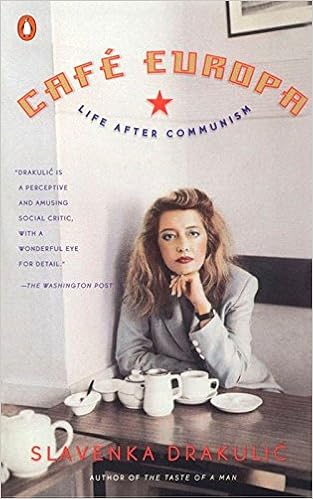
Cafe Europa: Life After Communism

Free PDF Cafe Europa: Life After Communism
After lot of times, book turns into one of the manners that will motivate the system of life run much better. It involves not only the ideas, ideas, opinion, however likewise the truths. Many truths have actually been disclosed from the books. Numerous literature jobs are additionally offered. When you have more time to read, please read this Cafe Europa: Life After Communism as one of the analysis materials!
Guides that exist come from several collections in the world. It implies that you will locate the hundreds publications from many authors and publishers from the globe. We recognize that such individuals will require the book from various other nation. If they need to spend much money to order and also wait on often times, you could get different methods here. Right here, you could quickly get the most convenient way to attach to the book as Cafe Europa: Life After Communism straight.
Well, still perplexed of how you can get this publication Cafe Europa: Life After Communism here without going outside? Simply attach your computer system or device to the web and also begin downloading Cafe Europa: Life After Communism Where? This page will certainly show you the web link page to download Cafe Europa: Life After Communism You never fret, your preferred e-book will be faster all yours now. It will certainly be much less complicated to appreciate reviewing Cafe Europa: Life After Communism by on the internet or getting the soft documents on your gizmo. It will certainly despite who you are and exactly what you are. This book Cafe Europa: Life After Communism is created for public and you are among them which could enjoy reading of this book Cafe Europa: Life After Communism
Why should be this on the internet book Cafe Europa: Life After Communism You could not should go someplace to read the e-books. You can read this e-book Cafe Europa: Life After Communism each time as well as every where you desire. Even it remains in our extra time or sensation burnt out of the tasks in the office, this corrects for you. Get this Cafe Europa: Life After Communism right now and be the quickest individual which finishes reading this publication Cafe Europa: Life After Communism
Review
"Insightful... This book not only helps to illuminate the political and social problems facing much of Eastern Europe, but also sheds new light on the daily life of its residents, their emotional habits, fears and dreams." —The New York Times"Drakulic is a perceptive and amusing social critic, with a wonderful eye for detail." —The Washington Post"Profound and often bitingly funny... you'll never think about capitalism, modern history, or your perfect, white, American teeth in the same way again." —Elle
Read more
From the Back Cover
Today in Eastern Europe the architectural work of revolution is complete: the old order has been replaced by various forms of free-market economy and de jure democracy. But as Slavenka Drakulic observes, "in everyday life, the revolution consists much more of the small things - of sounds, looks and images. In this brilliant work of political reportage filtered through her own experience, we see that Europe remains a divided continent. In the place of the fallen Berlin Wall, there is a chasm between East and West, consisting of the different way people continue to live and understand the world. Are these differences a communist legacy, or do they run even deeper? What divides us today? To say simply that it is the understanding of the past, or a different concept of time, is not enough. But a visitor to this part of the world will soon discover that the Eastern Europeans live in another time zone. They live in the twentieth century, but at the same time they inhabit a past full of myths and fairy tales, of blood and national belonging.
Read more
See all Editorial Reviews
Product details
Paperback: 224 pages
Publisher: Penguin Books; 1.2.1999 edition (February 1, 1999)
Language: English
ISBN-10: 0140277722
ISBN-13: 978-0140277722
Product Dimensions:
5.1 x 0.6 x 7.8 inches
Shipping Weight: 6.4 ounces (View shipping rates and policies)
Average Customer Review:
4.4 out of 5 stars
31 customer reviews
Amazon Best Sellers Rank:
#85,909 in Books (See Top 100 in Books)
This book is about the 1990's in Eastern Europe, especially in the Balkans. It seems slightly outdated, but it is so well written that it definitely kept me going. It reads very fast. The book gets better and better as you go on. Some of the very pessimistic prophecies of the author were wrong, but many of her observations and thoughts seem to be very accurate and straight to the point. The relationship with her own country is very troubled and most of the Non-Croat readers, without any deeper insight into regional politics, will not be able to fully understand her point of view. Whether she is right or wrong, she always writes well. Most of the time she is very pessimistic. The book is actually completely soaked in sadness. There is in it no sign of excitement about freedom, democracy or free market economy...Instead, there is a strong conviction that the peoples of Eastern Europe are not mature enough to benefit from and build on any of these. I personally don't agree; the results of the systemic changes in the region have been mixed, with some extremely successful and some extremely disappointing and troubling cases. In fact, the 1990's were the last decade when the region could be still discussed as one item. Today, these are all very different countries.
Drakulic delivers another series of short essays, in the style of her earlier "How We Survived Communism". In "Café Europa", the reader is carried from Croatia across western Europe during the few short years since Croatia emerged from war as an independent state, caught somewhere between its Balkan history and its European ambitions. She ruminates on subjects as far afield as her distaste for the word "we" because of its communist overtones, which leads to the verdict that the western concept of "I", of self-reliance and modernity in a civil state, is a notion still to be embraced in eastern Europe. It is for precisely the same reason that she admires Americans their fetish for perfect teeth, because they represent self-respect and independence from shoddy state-sponsored dental care.Many of the essays in the book deal with the peculiar talent in eastern Europe for hiding and forgetting the past, thereby evading responsibility and missing the opportunity to learn from it. This flair for forgetfulness causes Drakulic's mother to fear for the sanctity of her husband's grave, marked by a communist star vulnerable to those who would destroy symbols of forty years of communism. It is this same talent that allows fascist "Ustasha" symbols from the 1940s to be revived in the 1990s under the guise of nationalism. The same phenomenon that impels each generation of politicians to rename streets and plazas in order to avoid any public recognition of historical figures whose views place them, at least temporarily, on the wrong side of today's political fences. It is this same failure of history that forces a Croatian journalist to mince words and ask facile questions during an exclusive interview with Dinko Sakic, the notorious concentration camp commander.Drakulic is a bit exasperated when, on a visit to Israel, she is barraged with questions about Croatia's fascist role during World War II. "To grow up under communism means to live forever in the present. Once the final social order had been established, there was no need to look backwards - or forwards, for that matter.... Perhaps this is the reason why we are now, with this recent war, sentenced to live in the past. Sometimes I ask myself whether this is the punishment for our lack of interest in history, for our fear, silence and irresponsibility towards ourselves. For our ingnorance." She realizes that Croatia as a society has failed to examine and integrate the lessons of its fascist period, and this failure, this willful forgetfulness, is itself a type of evil complicity perpetually spawning new crises, including the high-tension ethnic conflicts that yielded the 1991-1995 wars.The only jarring note is the essay titled "Why I Never Visited Moscow", in which Drakulic bemoans the fact that she has been categorized as an eastern European writer. This seems a bit hypocritical given that all of "Café Europa" including the very cover blurbs, much like her previous books, is premised on the fact that she is a particularly talented eastern European writer and astute social critic who has interesting and insightful things to say about the region. Perhaps Drakulic, who has won awards, fame, and money with her admirable accounts of eastern Europe, is being a bit self-righteous when she complains about being viewed as an eastern European writer.
This is a good book, and one worth reading. It's not a history book nor a work of political philosophy. The analysis isn't rigrously done. I don't say these things as criticisms, but rather to point out what sort of book it is. It's a book of essays that provide a particular picture of what life was like in the early 90's in post-communist Eastern and Central Europe. Many times these pictures are insightful and can help throw light on a situaiton. They can help provide that "ah-ha!" moment that is sometimes lacking from a more historical or analytic account. So, it fills a good roll that way, but you should not expect it to be something it's not. My only other criticism is that sometimes it got a bit too close to the "why are we eastern europeans so dumb?" mode for my taste. But, it's an enjoyable book that would be useful for anyone with an interest in post-communist eastern europe. For those who want a deeper view of how Eastern Europe got to be how it was when the Soviet Union fell, I'd recommend reading this book together with parts of Alec Nove's terrific _The Economics of Feasible Socialism_.
This book may be a nineties look at how things will turn out in Europe, so some may say it's out of date, but its perspective on history makes it that much more valid. Drakulic's experience doesn't change, what happened to the East doesn't change. This book is a brilliant, detail-oriented look at how Europe was before and after the Soviet Union, and I want to read everything else she's written. Love it.
Slavenka Drakulic is both a skilled writer and a capable interpreter of the human condition. Cafe Europa is not a standard history text; rather it is a collection of related articles that reveal the attitudes, perceptions, and behaviors of individuals who have lived in both the communist world as well as the post-communist period. Drakulic is a great travel companion with a keen feel for the people that she writes about. I approached the book expecting a useful social commentary and found it to be both enlightening and difficult to put down. Anyone who wants to truly understand this part of the world needs to read this one!
Excellent book, Slavenka Drakulic is very perceptive and understands Balkan mentality better than anybody. I really enjoyed reading this book, and other books from Drakulic as well. Sometimes, it seems like Drakulic is balancing between two worlds-one of reality and the other of fantasy. Very good reading and it will give you an insight into the minds of people living in parts of Southeast Europe.
Cafe Europa: Life After Communism PDF
Cafe Europa: Life After Communism EPub
Cafe Europa: Life After Communism Doc
Cafe Europa: Life After Communism iBooks
Cafe Europa: Life After Communism rtf
Cafe Europa: Life After Communism Mobipocket
Cafe Europa: Life After Communism Kindle


0 komentar:
Posting Komentar